Growth that’s fast. Growth that lasts.
Many traditional PE conversations can sound the same…cost optimization, platforms, acquisitions, metrics, margins, multiple expansion. You know the drill.
But my conversation with Kanbrick was different. They aren’t just another variation of that model. They’re an alternative to it entirely.
Last week, I sat down with the team to unpack how they build companies, and within minutes you could feel the difference.
Even Co-founder Tracy Britt Cool’s early start hints at this. Growing up on her family farm in Kansas, she learned that great things are built brick by brick with integrity, discipline, and patience. Later, after a decade at Berkshire Hathaway and leading Pampered Chef, she channels that same grounded, long-term mindset into building enduring businesses, not quick wins (and lucky for us we get a window into that perspective through our network and our chat with the team).
For Kanbrick, the goal isn’t to amass assets or engineer fast value. While acquisitions can boost revenue in the short term, Kanbrick believes that without alignment and true coherence, rollups risk collapsing under their own weight. So their approach ensures that any expansion strengthens the platform… compounding value over decades, not quarters.
Whether you’re running a business, investing in one, or building the next big thing from scratch, there’s something seriously refreshing and useful in how they think. Build well, build patiently, and build with purpose.
So let’s get into it. In true Kanbrick spirit, let’s break it down
brick
by
brick
Their “portfolio” people
On paper, Kanbrick’s focus areas look familiar:
- Middle-market companies, $5M–$50M EBIT
- Often privately-held, founder or family-owned
- Across Industrial, Services, and Consumer sectors
But these details only explain the what. The how is where the distinction truly lies.
The real story starts with a timeline… or the lack thereof.
Kanbrick doesn’t start from a fixed timeline. They’re not built around a 3-5 year hold period with an exit at the end. They’re thinking in decades, focusing on relationships and businesses with an undefined time horizon. That single choice reshapes every other decision… who they invest in, who they hire, and how they operate.
And when you’re thinking decades, your first filter isn’t margin or TAM. It’s something far more fundamental, and way harder to fake.
Integrity.
The first rule: don’t rush the vet
A decades-long partnership is gonna require some decades-grade conviction. So the process starts way before any deal is made. For Kanbrick, the patience is the point.
This is a marriage. Perpetual, ever lasting. Not a short term “Monetize and run”.
For example, the team will often spend 2-4 years getting to know a founder and business before starting a partnership. That alone tells you how differently they think. Instead of concentrating on broad banker-led processes, they prioritize building genuine relationships and alignment. They want to get to know a team, and they want the team to get to know them.
A key element to this is the Kanbrick Community, a forum for CEOs and execs who want to learn and grow together through peer learning, hands-on programs, tools, etc.
No costs, no ego. Just an opportunity to share and learn together with CEOs.
What I love about this is that it naturally gives CEOs and owners an authentic window into how Kanbrick truly partners. And if and when a management team is ready for a long-term partner, much of the alignment work and foundation has already been laid!
How this creates superior value-creation
That level of alignment rewires the entire game. When you’re thinking in decades, value creation is gonna look a little different. A long-term orientation doesn’t mean ignoring performance. It just means building systems that produce results sustainably.
But done right, we’re looking at:
- Lower volatility with meaningful long-term upside
- The ability to drive a thoughtful strategy vs. driving tactics to hit a short-term exit threshold
- Stronger early alignment that reduces talent churn
- Transparent communication (no competing or hidden agendas)
- Better execution through joint ownership of strategy
- Fewer “gotcha” moments and greater trust across the partnership
- Ultimately, a moat that doesn’t overrun and flood itself with unrelated businesses, but true coherence that flows!
Put another way, this is capitalism that compounds. You trade some near-term optionality for a much higher probability of durable performance.
It all comes back to integrity and alignment
But of course there’s that pesky little thing of… change.
Things will evolve, and you have to account for that. Priorities shift, families grow, circumstances change. It all happens when you’re building. But integrity doesn’t change, and that’s exactly why it’s the bedrock of Kanbrick’s partnerships.
You have to be dogged in looking for integrity. And yes that takes time. It takes time to find those whose motivations, values, and integrity will align with the long-term vision from the very first deal, to 5, 10, or 100 deals down the line.
It’s clear culture and people aren’t secondary. They literally are the business for Kanbrick.
As Dawson, Kanbrick’s SVP of the Kanbrick Business System told me, “We actually never use the words portfolio or portfolio companies.”
It’s people and partners. Always has been. Always will be.
KBS: Bringing the long-term philosophy to life
Kanbrick’s long-term thinking isn’t limited to investments. It shows up everywhere from hiring, investor selection, and especially the Kanbrick Business System aka… KBS.
Many PE operating playbooks have the usual suspects of a few KPIs here, bolt on acquisitions, margin target here, a hiring plan to tie it all together, and voila…. value creation.
And that model has proven to work well for decades- which, great! But what about the businesses where this kind of approach just isn’t right for them? The ones that need an alternative?
That’s where KBS comes in. Instead of some of the more typical things you’d see, they talked people, basics, and alignment (notice a pattern?). This is Kanbrick’s framework rooted in 4 main pillars: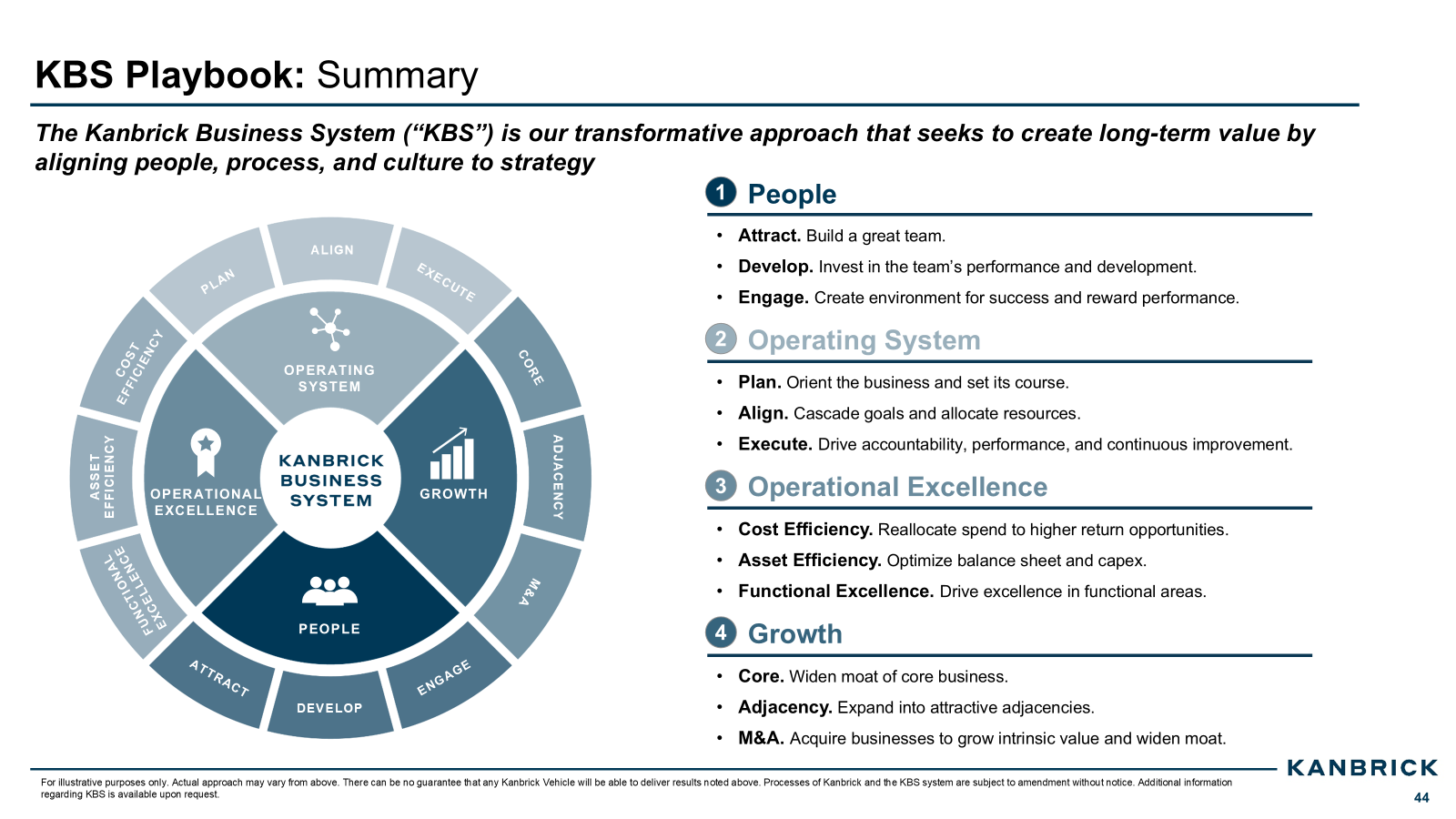
So what does this look like in practical terms?
- Working shoulder-to-shoulder with management over years, not quarters
- No sponsor/sponsee bureaucracies and the lines blur (yep) on purpose
- Shared ambition > mandating targets
- Hiring people who blend urgency with patience
- Building capabilities that compound over time
Take a look at their first-year approach that puts all this into perspective:
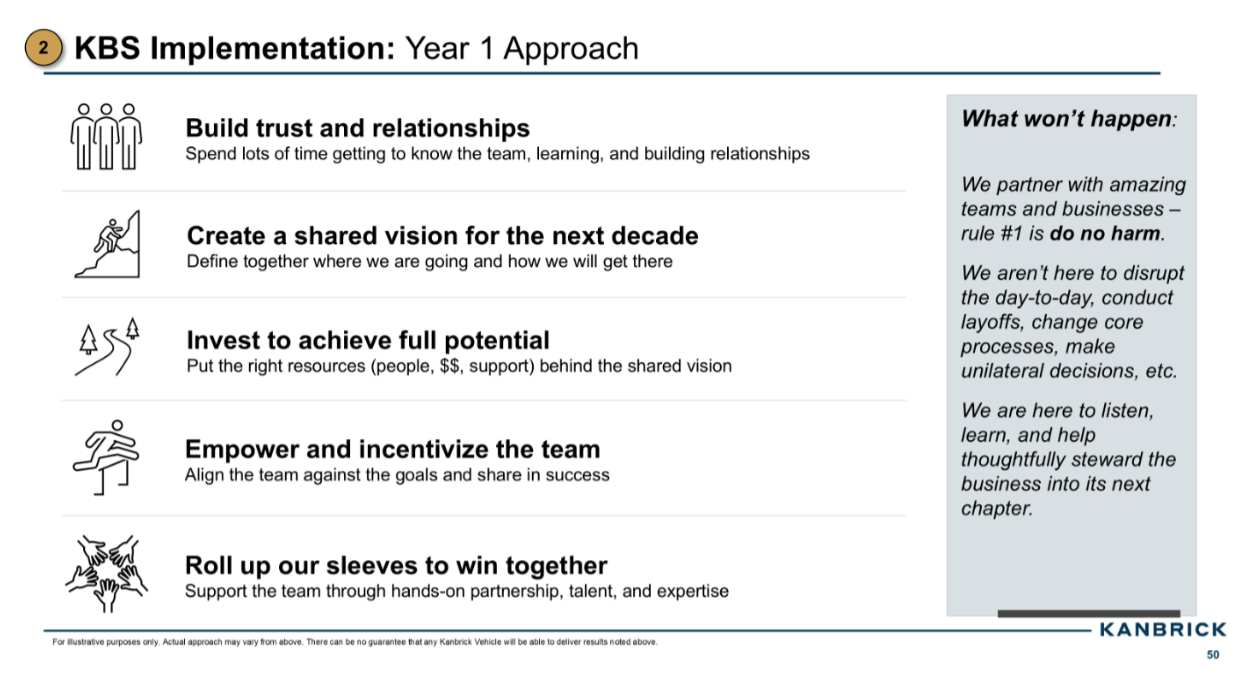
See a revenue goal somewhere? What about a shot clock to sell? Nope.
Ok ok. Let’s talk about the elephant in the room…
Talking about patience and decades-long thinking is one thing. But results still matter.
Growth matters. Returns matter.
So how do you actually reconcile long-term building with the very real pressure for performance?
Look. It’s incredibly hard to optimize for both at once. Demanding immediate acceleration while building endurance? Tough. Cultivating culture while constantly reshuffling people for short-term gains? Even tougher.
Kanbrick’s answer to this is deceptively simple…
“If you’re aligned from the start, that tension never needs to exist.”
Is that really possible? That…simple? And if it is, what does it look like in practice?
Their approach is built around removing misalignment before it can ever show up. They tackle the short-term vs. long-term tension with a few core principles:
- Alignment starts before the partnership, never after
Point blank. Their first filter for any investment is alignment on motivations and integrity. Values, not just valuation.
- Co-design the ambition upfront
Align on time horizon (3 years or 30?), the path to value creation, the founder’s desired role, and what the long-term goals are. The plan is built together, not handed down.
- Build operating systems that compound, not spike
Remember, KBS is built around durable pillars like people and culture that stand the test of time, not a 1-year timeline tied to a revenue goal.
- Hire for people who can hold the paradox
This is critical. You need folks capable of both urgency and patience. High performance with EQ and lived-in operating experiences. There's magic in this. Building an internal team that's all aligned in decades from day one and using that as a filter creates a totally different culture. It's really hard to pull off as Partners, associates, talent leaders, etc. They all have to be committed to the same mission with life moving in a variety of different ways.
- Choose investors who won’t force short-term thinking
A part most overlook. If your capital base expects rapid exits or quarterly markups, there is no sustainable way to play the long game.
Get this right and bring in the right team to support.
That’s how you reconcile the short term with the long game. And win at both.
In this careful, deliberate building, you glimpse something rare…
What might our world look like if more partners offered this kind of alternative path? Those who think in decades and build with care and integrity because that’s how they create value?
We might get a glimpse of business that’s more grounded, more durable, and more human.
So lay your brick. Build steadily. Have purpose. Find a damn good team that’s committed to doing the same.
I’ll see you there.