What comes next? The question every leader must answer
As humans, our natural inclination is to wonder: what will come next?
We gaze ahead, imagining possibility, risk, growth… because the future always demands it. It’s the same in business.
Every quarter, leaders ask the same existential question: What will tomorrow bring? Opportunity? Disruption? Or something far more destabilizing?
The executive trend threatening businesses’ futures
One trend is reshaping the future more quietly — but more dramatically — than any market cycle: executive churn.
Right now, executive churn is surging, and at an unprecedented pace. In 2025, U.S. companies have already recorded a wave of CEO exits: nearly 1,235 departures in just the first half of the year, the highest year‑to‑date total since tracking began.
Despite the list of possible reasons, every departure reverberates across organizations and carries a cost.
Decision-making slows.
Initiatives stall.
Teams stretch.
Productivity dips.
The organization reflexively leans on consultants, interim roles, or quick external hires, each one driving up cost and creating more uncertainty.
Suddenly, leaders must solve a dual equation: growth and continuity, with the same (or fewer) people.
As 2026 planning accelerates, pressure on executives continues to intensify:
- Market volatility
- Aggressive growth goals
- AI transforming workflows
- Headcount budgets under scrutiny
Teams are being asked to move faster, smarter, and with greater impact — without simply adding headcount. And in a world where leadership turnover is accelerating, the instinct is often to “go hire or backfill.”
Boards scrambling for external hires, consultants being used as stopgaps, and unnecessary headcount inflation — all symptoms of a leadership bench that only looked deep.
But is there another path that protects performance, continuity, and speed without necessarily inflating payroll?
Succession planning: The most underused headcount lever
Unprepared leadership creates slowdowns, inefficiencies, and risk. And right now, that risk is higher than ever. A deep, ready bench of internal leaders is the difference between an organization that absorbs disruption and one that gets derailed by it.
And yet, most companies don’t have one.
Consider the following
- A 2025 leadership report revealed only ~ 49% of critical business‑leadership roles in organizations can be filled immediately by internal candidates.
- Insight: More than half of companies don’t have internal readiness: when a vacancy or disruption happens, internal bench strength often isn’t sufficient — leading to delays, external hiring, or productivity losses.
This might explain why organizations overspend on external hires, inflate headcount unnecessarily, or stretch teams to the breaking point. The issue isn’t necessarily just tied to capacity, but leadership readiness.
Succession planning is, yes, a risk-mitigation exercise. But it’s also a productivity strategy.
A continuity strategy.
A headcount strategy.
And right now, it is one of the most overlooked levers of efficiency and headcount available to executives.
A practical roadmap for executives: Turning succession into a multiplier
Through our work with high-growth organizations and years of executive search experience, we’ve identified some of the most effective approaches to making succession planning a true performance lever.
Every company’s context is unique, and there’s no one-size-fits-all approach; think of this framework not as a step-by-step guide, but as a way to view and strengthen your leadership bench.
1. Map your critical roles.
Identify positions with the greatest impact on revenue, growth, efficiency, or strategic shifts. Flag roles whose vacancy would disrupt execution.
2. Assess internal bench strength honestly.
Look beyond tenure and titles. Evaluate:
- Adaptability
- Cross-functional fluency
- Decision-making speed
- Ability to operate under complexity
Leaders who can flex across multiple business needs reduce your dependence on external hires.
3. Build purposeful versatility.
Expose high-potential leaders to different business functions, critical initiatives, or high-stakes projects. Building versatility now reduces the need for roles in the future.
Rotations, stretch assignments, and high-stakes project ownership do more than “develop talent.”
They create optionality — the ability to plug leaders into urgent gaps without breaking momentum or adding headcount.
4. Plan for scenarios, not just successions
Structure your succession strategy around moments that matter:
- A sudden departure
- A business model shift
- A restructuring
- A new growth mandate
Future-ready leaders are those who can be immediately redeployed against shifting priorities.
What makes an effective succession strategy?
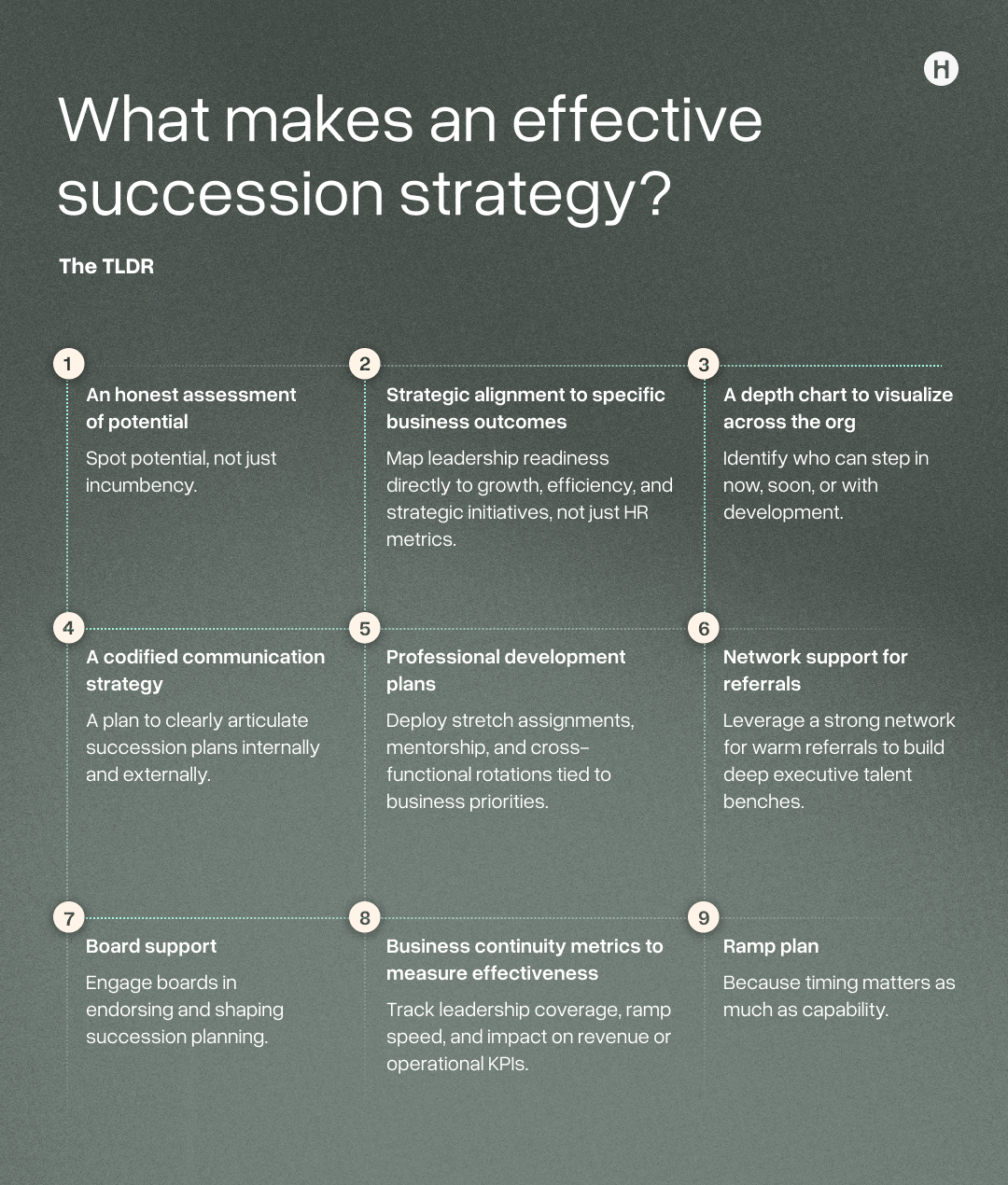
An effective succession strategy is a comprehensive system that aligns leadership readiness with organizational outcomes, unlocking latent capacity across the business. Here are the elements that distinguish high-performing succession programs:
1. An honest assessment of potential
- Evaluate more than past performance: adaptability, decision-making under pressure, cross-functional competence.
- Focus on leaders who can thrive in uncertainty and rapidly shifting priorities.
- Takeaway: Spot potential, not just incumbency.
2. Strategic alignment to specific outcomes
- Map leadership readiness directly to growth, efficiency, and strategic initiatives.
- Ask which leaders can accelerate revenue or operational impact without adding headcount?
- Takeaway: Succession drives business results, not just HR metrics.
3. A depth chart to visualize across the org
- Identify who can step in now, soon, or with development.
- Highlight gaps, overlaps, and potential single points of failure.
- Takeaway: This tactic can help turn talent into a predictive tool for organizational resilience.
4. A codified communication strategy
- Clearly articulate succession plans internally and externally.
- Reduces uncertainty, retains top talent, and signals preparedness.
- Takeaway: Transparency accelerates trust and execution.
5. Professional development plans
- Deploy stretch assignments, mentorship, and cross-functional rotations.
- Tie development directly to upcoming business priorities for measurable ROI.
- Takeaway: Development accelerates readiness and multiplies impact.
6. Network support for referrals
- Leverage a strong network for warm referrals to build deep executive talent benches.
- A connected ecosystem helps surface hidden talent, accelerates readiness, and creates multiple pathways for leadership growth.
- Takeaway: Networks expand your talent radar, reduce blind spots, and ensure the right leaders are ready when opportunities arise.
7. Board support
- Engage boards in endorsing and shaping succession planning.
- Aligns leadership development with long-term strategy and market confidence.
- Takeaway: Board involvement ensures continuity is strategic, not reactive.
8. Business continuity metrics and KPIs to measure effectiveness
- Track leadership coverage, ramp speed, retention of high-potential talent, and impact on revenue or operational KPIs.
- Takeaway: Data-driven oversight turns succession into a P&L lever.
9. Ramp plan
- Clarify how quickly a leader can be deployed (weeks, months, or longer).
- Link readiness to specific milestones for precise resource planning.
- Takeaway: Timing matters as much as capability.
The future will always keep us wondering. The unknown will always feel daunting. But the right leadership will be ready.
Succession planning is often framed as preparation for a vacancy — sudden or anticipated. But its real power lies in possibility: the ability to equip your organization to move with speed, resilience, and clarity, without inflating headcount.
If tomorrow is uncertain — and it always is — then the organizations that win will be the ones that treat succession not as a contingency… but as their most powerful lever of productivity.
Ready to build for whatever comes next?