AI Competency in Customer Success Hiring: A Tactical Guide and Assessment Tool
Customer success used to be judged on whether customers were happy, but is now increasingly driving revenue and higher-order business impact. For example, CSATs are becoming an anecdotal metric of the past and customer success leaders now carry NRR as their own target and sometimes even sit in forecast reviews next to sales.
Now, layer in AI right in the middle of this shift. We’ve been at the forefront of both of these evolutions in the function, with a clear view of what’s actually happening. This guide is meant to help assess AI competency in CS leaders against a changing backdrop that ladders up to revenue growth more and more.
Need more guidance? Every hiring process, and every company, is different. This guide is meant to be a directional tool, not a rigid rubric to apply wholesale. Please use it to sharpen your own process. If you want more tailored support getting a specific customer success hire right, reach out to Hunt Club.
Market Signals: What’s Shifting in Customer Success, and What Each Shift Changes About Hiring
- 01What’s shifting in marketThe revenue mandate arrived faster than a way to deliver on it. Companies gave customer success the retention and expansion number, then staffed for it the only way they knew how: more CSMs. But in Bain’s December 2025 research, NRR declined across software companies even while those same companies invested in more customer success roles. The function got bigger and more important, and the results went flat. That’s the backdrop for every CS req being written right now. How this impacts hiringThe backfill instinct is the trap. If the last three hires didn’t move NRR, a fourth of the same shape won’t either. But now, AI lets you first decouple coverage from headcount. So ask candidates what they’d do with your current book and no new hires.With tighter headcount, the one seat you get has to change the motion with strategic AI leverage, and that’s what you want to assess for.
- 02What’s shifting in marketTwo-thirds of the CSM week is automatable, but almost nobody has automated it in a meaningful, top-down way.
Bain found CSMs spend roughly 65% of their time on lower-value work that AI could absorb, and separately, that about 70% of CS leaders aren’t yet using AI meaningfully, with very few of those who started ever scaling past a pilot. Gainsight also found AI in CS is largely bottom-up, individual CSMs picking up tools for their own productivity rather than working from a mandate.
How this impacts hiringNearly every candidate will claim AI fluency, and most of them will be describing personal productivity (preps their calls, drafts emails, etc.). With few CS leaders past the pilot stage, the candidate with a proven top-down AI track record might not fully exist yet, and holding out for one will keep the req open.
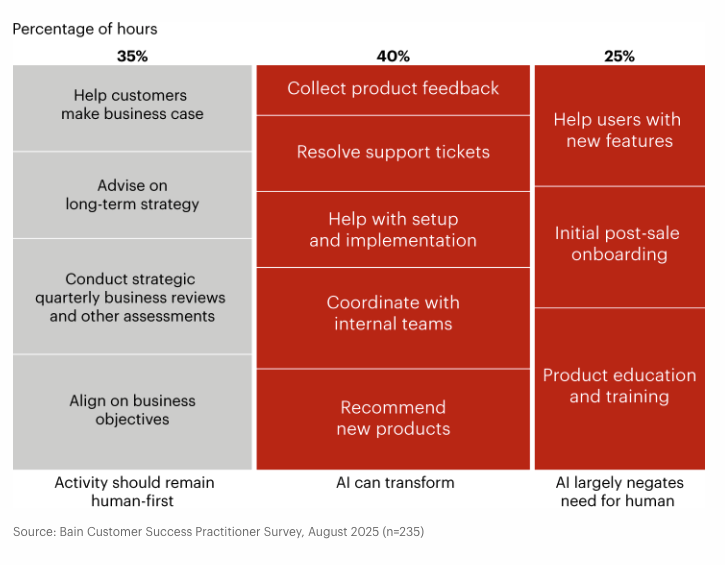 Bain’s breakdown of where CSM hours actually go. Worth reading as a hiring map: the 35% on the left is what you are really assessing for, and the 25% on the right is what a candidate should already have handed off.
 - 03What’s shifting in marketThe case for senior hires. As we’ve seen, there’s more scattered AI use cases and AI layers tacked onto outdated or personal tasks vs. AI being treated as a strategic priority from the top-down. The function typically lacks the size or visibility needed to command CEO-level sponsorship, which might change the level of seniority you need here. How this impacts hiringIn addition to constricted headcount, this is one of the clearest arguments for hiring at a more senior level. The work only lands if someone drives it from the top: securing the mandate, building the case for the CEO and CFO themselves rather than waiting to be handed one, standing up the systems designs, and pushing adoption through a team that liked the old way. You are hiring the sponsor, not a sponsee.
- 04What’s shifting in marketThe function keeps absorbing scope, and the titles and comp are multiplying to match. As mentioned, CS is increasingly being shaped closer to a revenue function (this is in addition to still being tied to renewals). At the same time, AI pushed the function into technical territory. New titles naturally followed: forward-deployed CSMs, consumption leads, AI CS ops, directors of AI customer strategy. The market is producing these fast with role definitions evolving in real time. How this impacts hiringOn comp, customer success is now priced against a different job category entirely. As more CCOs own revenue growth, plus retention, plus renewals, companies are benchmarking them against GTM leaders instead of support leaders. That is most visible in larger PE-backed and IPO-track companies where CS has become a core GTM function, which means a band borrowed from your last CS req will read low.See our salary guides and more compensation trends: PE-backed / VC-backed
- 05What’s shifting in marketWhen the product is AI, getting customers live gets a whole lot trickier. Traditional implementation had a pass/fail bar: it either fires or it doesn’t. AI output has no such bar. Two customers can deploy the same way and get different quality, because it depends on their data, their workflow, and what they expected. So the job shifts from did we configure this correctly to did we build something good enough for their real work, and if not, why. How this impacts hiringImplementation has mostly been a project management hire: sequencing, stakeholders, training, go-live. If your product’s value rides on AI output, though, that seat needs someone who will dig into the customer’s data, rewrite the prompt, or tell the customer their process is the problem, which is closer to solutions engineering and prices like it.