How We Deployed and Actually Made AI Compound at Hunt Club
What do you do when everything works, but nothing compounds?
Most companies I talk to have tried one of two approaches to deploying AI within their org.
At Hunt Club we executed on all of these and while they all “worked” in a technical sense and produced value, none of it truly compounded.
Skills were the clearest example. Within weeks of learning that a Claude session could yield a reusable skill, several people had their own write-up skill and their own candidate scorecard format. Each of them got faster, but as a company, we created divergence. The same client of ours could get deliverables that looked like they came from two different firms.
Thrilling to watch. Daunting to watch sprawl.
I could point at real wins but could not explain what we were holistically building. And while this was incredibly thrilling to watch what our teams could suddenly do, it was also daunting to watch how fast it could sprawl.
A skill here, an automation there, a cool dashboard somebody spun up on a Tuesday (and stopped using by Friday)...
The way I put it to a PE firm we were trading notes with recently: you end up with 50 agents that each do one thing well and 100 employees that get better at “using AI” and yet nothing really connects. You stay AI enabled and never cross over to AI native.
We had to stop the scattershot approach to deployment
No more playing whack-a-mole with problems. We stopped and took stock, defining the broadest areas of value/impact that AI could provide us. Then, we created a strategic sequence by which we would build to extract optimal value.
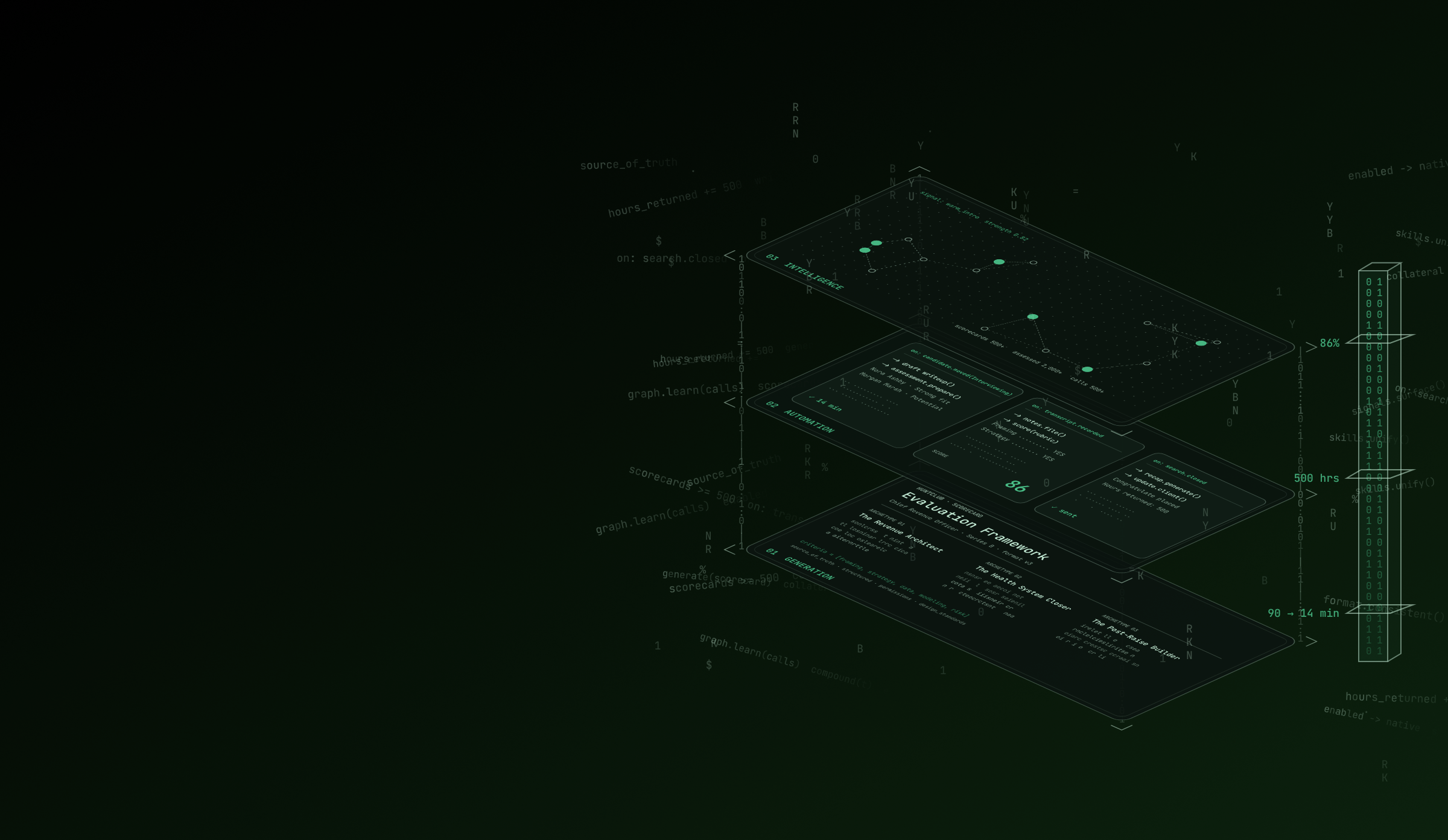
Generation, then Automation, then Intelligence.
These three categories were not novel. But the discipline to build sequentially, despite temptations to spread out, was novel for us (and it will be for many AI-enabled businesses).
Building and deploying in 3 sequential phases
Somebody sits down, decides something needs to be done, and asks for it. A document, an analysis, a list, etc. at a quality the whole team can rely on.
An important note on “Generation” that many miss
“Generation” is not just a fancy word for “AI spins up documents.”
While tools like Claude Docs and Claude Design are certainly helpful, they handle the most superficial layer of Generation: presentation. Relying on them alone would have meant storing our most valuable data in someone else’s system.
Because we were solving Generation across every piece of collateral and content we create, what we actually needed was a holistic content management system built for that purpose: a single source of truth, centralized and structured data, consistent formats and methodology, separation of content from presentation, our talent’s unique insights and skills, permissions and access controls, and design system standards that Generation can thus successfully run off.
We would never have gone to this depth if the remit was simply “automate candidate assessments.”
How we run it today
After systematically testing the above sequence, every step of a search at Hunt Club now runs differently.
Here’s a quick rundown of our processes as an AI-native search firm in 2026:
- GenerationWe calibrate a search with the client as part of the BD process before we even have the deal signed to ensure alignment.
- GenerationAfter the kickoff call, our team generates the scoring rubric, which is used to evaluate candidates.
- AutomationCall notes file themselves and candidate write-ups/assessments are automatically drafted and presented for review as candidates move through the funnel.
- IntelligenceRelationship signals that used to live in one person’s head are now surfaced in our operating system when relevant and actionable. Over time, the core intelligence system keeps learning from them.
All of this used to be much slower, less consistent, and entirely manual. To illustrate the efficacy of our new system in place, the process of creating a single candidate write-up went from ~90 minutes to roughly 14. Across the team, conservatively 500 hours came back to us in the first month alone. To date we’ve eliminated 86% of time spent on collateral generation. Time that can now go to more valuable activities for our business: most importantly spending more time with our customers and candidates.
It’s an incredibly exciting transformation. It is also easier to show versus tell, so here is a small example of what this looks like live:
Where did the sequence/order come from?
The Generation, Automation, Intelligence sequence was born from first-hand challenges.
The acute pain was the disparity of deliverables we put in front of clients. Formats diverged from person to person. Quality varied with who produced it and what data they had access to. Artifacts took hours to produce.
So, we needed to solve for Generation first. We needed to raise the quality of everything we put in front of clients for the whole organization.
Once we focused on Generation, the subsequent build stages became clear. If our entire organization improved at generating customer deliverables and content, automation should be a short leap.
And every scorecard, assessment and client update saved in one place, in a consistent structure, would become the raw material for Intelligence.
Why does the order even matter?
Anything of value I have ever helped build has followed the same model: get really good at one thing, layer in the next, then the next, and keep building on it. Let’s talk about 4 actual practical reasons why order matters:
It’s much more manageable to troubleshoot and iterate on one new thing at a time.
During Generation the only question is whether the output is good. In Automation, the new question is whether the work was completed at the right moment. Ship both at once, and if something goes wrong, you can’t tell whether it was the Generation or the Automation.
Bad output or bad trigger?
Automation gets dramatically cheaper once Generation is solved/reliable.
Once you can produce consistent, trustworthy work on demand, you’ve built reliable safeguards the Automation step can run off. What’s left is deciding which moments to listen for (e.g., a candidate moves to Interviewing, a search closes, a transcript is recorded) and wiring those triggers to mechanisms that already exist.
Intelligence is supply constrained, and you control the supply.
A while back, we put a number on what Intelligence would need before it was worth putting significant resources behind. I needed roughly 500 scorecards, 2,000 candidates assessed, 500 calls analyzed. Below that, any pattern the system finds is noise.
Today we’ve cleared those milestones by a long shot. That’s a real answer to “should we be building forecasting yet,” and we wouldn’t have it if we’d started at Intelligence.
Your people come with you.
Go straight to Automation and you skip over your people and end up with even costlier hiring mistakes later (we see it often). But starting with Generation keeps an employee in the driver’s seat. That’s the goal.
None of this compresses judgment or relationships and the talent we need to maintain these two things. But compressing document work matters because it hands hours back to recruiters, who spend them with candidates and clients instead of writing up conclusions they’d already reached. (That’s one of the main arguments our CEO made in The Market Misunderstands AI-Native Services.)
Our people are the ones who see what goes in, what comes out, and where it all falls short. By the time anything runs on its own, the team has generated hundreds manually, and Automation arrives as a relief.
Where will you start?
Your first phase may not be Generation.
We started there because our immediate pain was the speed and quality of our deliverables. If your pain is a process that simply needs to happen reliably behind the scenes, you might start with Automation. Whichever you decide, remember, the specific order matters less than running one phase at a time.
We’ll write up the Intelligence phase when we have learnings to share later this year. Until then the advice is straight-forward on purpose:
Pick an order, and stick to it.